
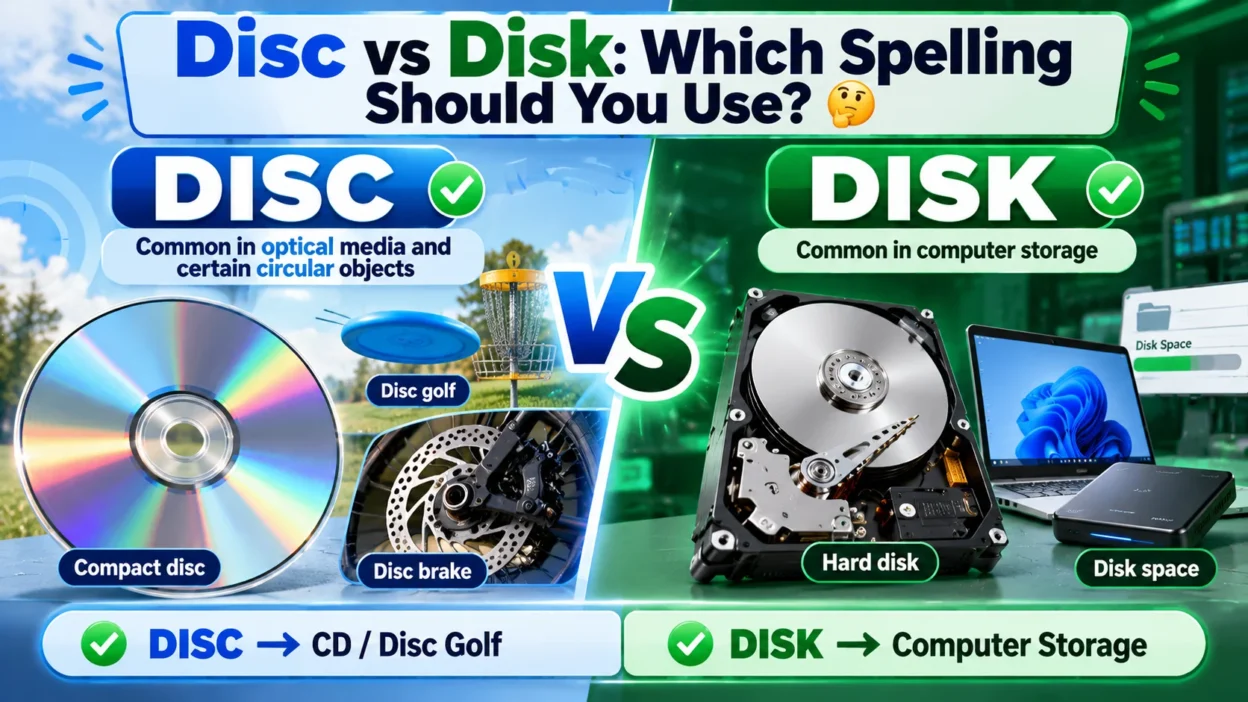
Have you ever wondered whether you should write disc vs disk when describing something round, a computer storage device, or a CD? Both spellings look and sound almost identical, but English speakers use them differently depending on context, region, and established terminology. British English often favors disc, while American English commonly uses disk, especially in general usage and computing. You will usually see hard disk, floppy disk, and disk drive, while compact disc, disc golf, and disc brake traditionally use disc. In this guide, you’ll learn the meanings, pronunciation, differences, origins, examples, and common mistakes associated with disc and disk.
🔍 Disc vs Disk: Quick Answer
Both disc and disk refer to a flat, round object. They also have the same pronunciation, /dɪsk/.
| Term | Meaning | Common Usage | Category |
|---|---|---|---|
| Disc | A flat, circular object | British English, CDs, sports, some medical terms | Noun |
| Disk | A flat, circular object | American English, computing, storage | Noun |
| Compact disc | Optical storage medium | Music and data | Technology |
| Hard disk | Computer data-storage medium | Computers | Technology |
| Disc golf | Sport played with flying discs | Recreation | Sports |
| Disk drive | Device for reading or storing data | Computing | Technology |
| Slipped disc | A spinal disc problem | British English | Medical |
| Slipped disk | Same basic medical reference | American English | Medical |
The important point is simple: neither spelling is automatically wrong. Context often determines which form you should use.
📚 What Does “Disc” Mean?
Disc means a flat, round object. You can use it for physical objects, technical terms, sports equipment, and anatomical structures.
For example, a compact disc stores digital information, while a disc brake uses a circular component to help stop a vehicle. You can also use disc when you talk about disc golf or a spinal disc.
British English commonly favors disc in many general contexts. American English also uses disc in several established expressions, so you should not treat the word as exclusively British.
🗣️ Pronunciation of Disc
Speakers pronounce disc as /dɪsk/. The word rhymes closely with risk, brisk, and frisk.
Its pronunciation does not change when you switch from disc to disk. Only the spelling changes.
🧩 Part of Speech
Disc functions primarily as a noun.
Examples:
- The disc contains the movie.
- The athlete threw the disc.
- The doctor examined the spinal disc.
💻 What Does “Disk” Mean?
Disk carries the same basic idea of a flat, circular object, but English speakers strongly associate it with computing and digital storage.
You will commonly encounter phrases such as hard disk, disk drive, disk space, disk storage, disk image, and floppy disk.
American English generally favors disk for computer-related terminology. Many international technology terms also preserve disk because computing developed a standardized vocabulary around expressions such as disk drive and hard disk.
💾 Disk in Computing
In computer terminology, disk usually refers to a storage medium or technology associated with storing data.
For example:
I need more disk space to install the program.
Here, disk space refers to available storage capacity.
You may also see:
- hard disk
- hard disk drive
- disk drive
- floppy disk
- disk space
- disk storage
- disk partition
- disk image
- disk cleanup
These established technical terms normally keep the k spelling.
🌍 Disc vs Disk in British and American English
Regional English helps explain much of the confusion.
British English often prefers disc as the general spelling for a flat circular object. American English frequently uses disk as the general alternative.
However, both varieties contain exceptions because certain expressions developed their own conventional spellings.
| Context | Common Spelling |
|---|---|
| General circular object | Disc / disk |
| British general usage | Disc |
| American general usage | Disk |
| Computer storage | Disk |
| Hard disk | Disk |
| Floppy disk | Disk |
| Compact disc | Disc |
| Disc golf | Disc |
| Disc brake | Disc |
| Spinal disc | Disc / disk |
| Optical disc | Disc |
This means you should consider the established expression, not just the country of your audience.
✍️ Disc vs Disk: 10 Useful Examples
| Example Sentence | Meaning |
|---|---|
| I bought a new disc for the game. | A circular physical object |
| She threw the disc across the field. | A flying sports disc |
| We listened to the music on a compact disc. | An optical music medium |
| The computer has a large hard disk. | A computer storage device |
| My laptop needs more disk space. | Available digital storage |
| He collects old discs from different bands. | Physical music media |
| The player threw the disc toward the target. | Disc golf equipment |
| The technician checked the disk drive. | Computer hardware |
| The doctor examined the spinal disc. | Anatomical structure |
| The program created a disk image. | A digital copy of storage data |
Notice how context naturally guides the spelling. Technology terms often favor disk, while physical, sporting, and optical-media expressions frequently use disc.
📝 Disc vs Disk: Common Synonyms
Because both words describe a circular or disk-shaped object, several related words can appear in similar contexts.
| Synonym | Meaning |
|---|---|
| Circle | A round shape |
| Plate | Flat circular object |
| Roundel | Small circular design |
| Ring | Circular band or shape |
| Medallion | Flat decorative circular object |
| Token | Small object used as a marker |
| Record | Recorded information or music |
| Drive | Computer storage mechanism |
| Storage medium | Device or material that stores data |
| Platter | Circular storage component |
| Rotor | Rotating circular component |
| Platelet | Small flat biological structure |
| Puck | Small flat circular object |
| Wafer | Thin, flat circular material |
| Diskette | Small magnetic storage disk |
The best synonym depends on the context. You should not replace disc or disk with any of these words automatically.
🔄 Related Terms You Should Know
Learning related expressions can help you remember the spelling difference.
| Related Term | Meaning |
|---|---|
| Compact disc | Optical medium for digital information |
| Optical disc | Disc that stores data using optical technology |
| Disc golf | Sport involving flying discs |
| Disc brake | Brake system using a rotating disc |
| Spinal disc | Cushion between spinal bones |
| Herniated disc | Damaged or displaced spinal disc |
| Hard disk | Magnetic computer storage |
| Disk drive | Hardware that reads or stores data |
| Disk space | Available computer storage |
| Disk image | Digital copy of storage contents |
| Floppy disk | Older removable magnetic storage |
| Disk partition | Logical section of a storage device |
| Diskette | Another name for a floppy disk |
| Discography | Collection or catalog of recordings |
| Disc-shaped | Having a flat circular form |
⚠️ Common Disc and Disk Mistakes
Many mistakes happen when writers apply one spelling to every situation.
| Mistake | Correct Usage |
|---|---|
| Hard disc drive | Hard disk drive is the standard computing term |
| Floppy disc | Floppy disk is the standard term |
| Disk golf | Disc golf is the established sport name |
| Compact disk | Compact disc is the standard expression |
| Disc space | Disk space is the common computing term |
| Disk brake | Disc brake is widely used |
| Disk golf player | Disc golf player |
| Disc drive | Disk drive is the common computing term |
| Diskography | Discography refers to a catalog of recordings |
| Disc image | Disk image commonly refers to a digital storage image |
Some expressions can vary by region, so always consider the dictionary, style guide, industry, or established terminology for your audience.
🎯 When Should You Use Disc?
Choose disc when the established expression calls for it or when you follow a spelling convention that prefers disc.
You will commonly see it in:
- compact disc
- optical disc
- disc golf
- disc brake
- spinal disc
- discography
- disc-shaped
British writers may also choose disc more broadly when referring to circular objects.
💽 When Should You Use Disk?
Choose disk when you discuss computers, digital storage, or an established technical term.
Common examples include:
- hard disk
- disk drive
- disk space
- floppy disk
- disk image
- disk partition
- disk storage
- disk cleanup
If you write technical content for an American audience, disk will often fit naturally in computing terminology.
❓ Frequently Asked Questions About Disc vs Disk
🤔 Is “disc” or “disk” correct?
Both spellings are correct. Disc and disk share the same basic meaning, but established expressions and regional conventions determine which spelling people normally use.
🇺🇸 Do Americans use “disc”?
Yes. Americans use disc in several established terms, including disc golf, compact disc, and disc brake. American English does not use disk for every possible context.
🇬🇧 Do British people use “disk”?
Yes. British English uses disk in some technical contexts, especially computing. For example, hard disk remains a common computing term.
💻 Is it “hard disk” or “hard disc”?
Hard disk is the standard modern computing expression. You should normally use hard disk and hard disk drive when discussing computer storage.
💿 Is it “compact disc” or “compact disk”?
The established term is compact disc, usually abbreviated as CD.
🏌️ Is it “disc golf” or “disk golf”?
The established sport name is disc golf. The sport uses flying discs rather than traditional golf balls.
🗣️ Do “disc” and “disk” sound the same?
Yes. In standard English, both words normally have the pronunciation /dɪsk/.
📖 Which spelling should I use in an essay?
Follow your audience and your style guide. For general British English, disc often fits better, while American English may favor disk. Always preserve established technical expressions such as hard disk and compact disc.
🧠 Conclusion
The disc vs disk difference becomes easier when you focus on context rather than memorizing one strict rule. Both words describe a flat, circular object and share the same pronunciation, but English uses each spelling in different situations. Use disc in expressions such as compact disc, disc golf, disc brake, and discography. Use disk in common computing terms such as hard disk, disk drive, disk space, and disk image. British English often favors disc, while American English frequently uses disk. When you write, check the established expression and choose the spelling that naturally fits your context.

Andrew Foster is a researcher and content writer at Differopedia, specializing in clear, accurate, and easy-to-understand comparison guides, definitions, and informational articles. His work focuses on helping readers make informed decisions through well-researched, reliable content.