
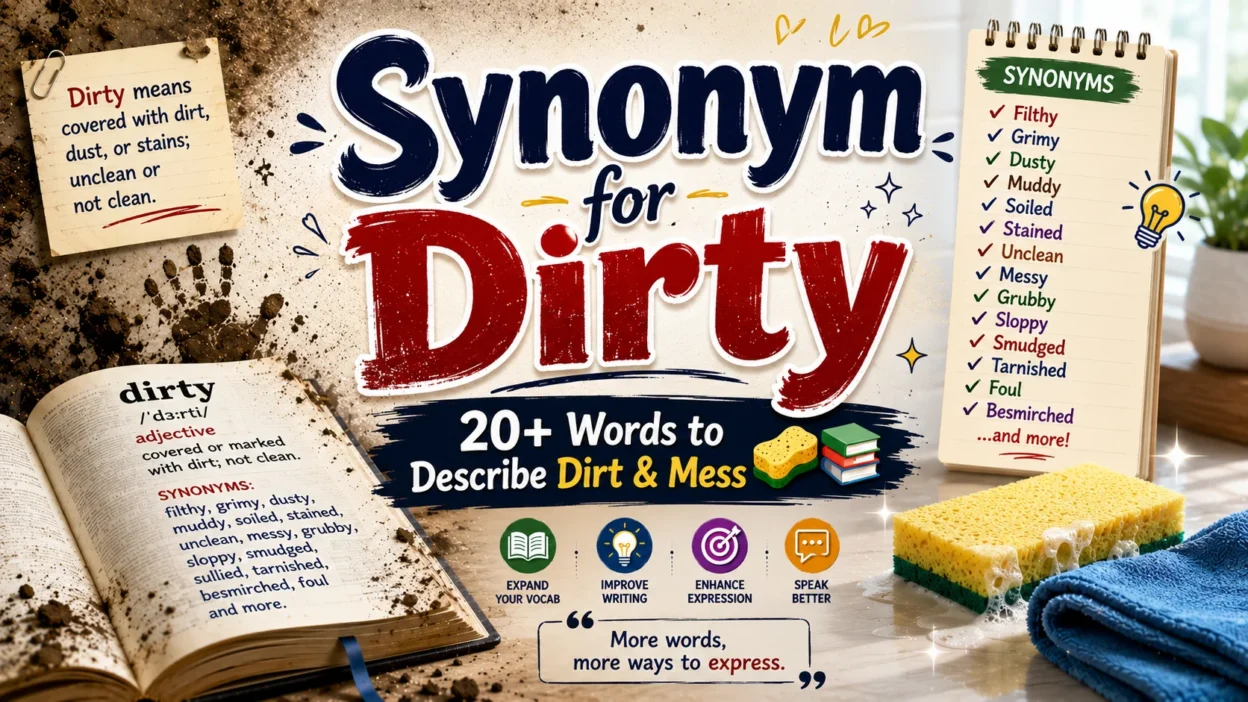
The best synonym for dirty depends on what you mean by dirty. If something has dirt on it, you might call it unclean, filthy, grimy, soiled, muddy, dusty, or stained. If you mean untidy, messy or unkempt may be more accurate. In figurative expressions, dirty can mean dishonest, unfair, vulgar, or offensive, so words such as underhanded, dishonest, crude, or obscene may fit better.
Because these words are not exact substitutes in every situation, context matters. A dictionary-style approach looks at the specific sense of dirty, the strength of the word, and the situation in which it naturally appears.
Quick Answer
The closest general synonym for dirty is unclean. Stronger alternatives include filthy and grimy. Soiled means made dirty, especially by contact with something. Muddy, dusty, and stained describe particular kinds of dirt, while messy usually means untidy rather than physically unclean.
Word at a Glance
| Word | Meaning | Example |
|---|---|---|
| Dirty | Not clean | My shoes are dirty. |
| Unclean | Not clean or hygienic | The kitchen was unclean. |
| Filthy | Extremely dirty | The floor was filthy. |
| Grimy | Covered with dirt or grease | His hands were grimy. |
| Soiled | Made dirty | She changed the soiled sheets. |
| Muddy | Covered with mud | His boots were muddy. |
| Dusty | Covered with dust | The shelf was dusty. |
| Stained | Marked or discolored | Her shirt was stained. |
| Messy | Untidy or disorganized | His room is messy. |
| Unsanitary | Unhygienic or unhealthy | The conditions were unsanitary. |
What Does “Dirty” Mean?
Dirty is an adjective with several related meanings.
Its most common meaning is not clean or covered with dirt or an unwanted substance.
The children came inside with dirty shoes.
It can also describe something that has become contaminated or unpleasant:
The dirty water was unsafe to drink.
In other contexts, dirty describes dishonest or unfair behavior:
The team won by using dirty tactics.
It can also describe language, jokes, or behavior that is vulgar, offensive, or sexually suggestive:
He told a dirty joke.
These different meanings explain why choosing a synonym requires attention to context.
Top Synonyms for Dirty
1. Unclean
Unclean is one of the closest general synonyms for dirty. It means not clean, and it can also suggest poor hygiene.
Examples:
- The restaurant was closed because the kitchen was unclean.
- The water looked unclean.
Usage: Unclean is slightly more formal than dirty and works well in writing about hygiene, sanitation, and cleanliness.
Formality: Neutral to formal
Tone: Neutral
Best context: General cleanliness, hygiene
2. Filthy
Filthy means extremely dirty. It is much stronger than dirty and often communicates disgust or strong disapproval.
Examples:
- His work clothes were filthy after the construction job.
- The abandoned house was filthy.
Usage: Use filthy when something is far beyond ordinary dirtiness.
Formality: Informal to neutral
Tone: Strong
Best context: Severe dirt or unpleasant conditions
3. Grimy
Grimy means covered with a layer of dirt, grease, or grime.
Examples:
- His hands were grimy after repairing the car.
- The old windows had become grimy.
Usage: This is a particularly useful word for dirt that has accumulated over time.
Formality: Neutral
Tone: Descriptive
Best context: Hands, machinery, windows, walls, surfaces
4. Soiled
Soiled means made dirty, usually through contact with a substance.
Examples:
- Put the soiled clothes in the washing machine.
- The nurse replaced the soiled sheets.
Usage: Soiled is more formal and often sounds clinical or professional.
Formality: Neutral to formal
Tone: Professional
Best context: Clothing, bedding, towels, fabric
5. Muddy
Muddy means covered with or containing mud.
Examples:
- My shoes are muddy after the rain.
- The dog left muddy footprints on the floor.
Usage: Muddy is more specific than dirty. It should normally be used when mud is involved.
Formality: Neutral
Tone: Everyday
Best context: Shoes, clothing, roads, yards
6. Dusty
Dusty means covered with dust.
Examples:
- The books were dusty because they had been stored for years.
- She wiped the dusty table.
Usage: Choose dusty when dust is the main source of the dirt.
Formality: Neutral
Tone: Neutral
Best context: Books, furniture, shelves, rooms
7. Stained
Stained means marked or discolored by a substance.
Examples:
- The carpet was stained with coffee.
- He noticed a stained patch on his shirt.
Usage: Stained focuses on a visible mark rather than general uncleanliness.
Formality: Neutral
Tone: Neutral
Best context: Clothing, carpets, furniture, surfaces
8. Messy
Messy means untidy, disorganized, or lacking order. It is related to dirty but is not an exact synonym.
Examples:
- Her desk is messy but clean.
- The children’s room became messy after they played.
Usage: Use messy when disorder is the main problem.
Formality: Neutral
Tone: Mild
Best context: Rooms, desks, hair, belongings
9. Unsanitary
Unsanitary means unhealthy or unhygienic because of poor cleanliness or sanitation.
Examples:
- The inspector found unsanitary conditions in the kitchen.
- The workers complained about unsanitary facilities.
Usage: This word is stronger and more technical than dirty. It suggests a potential health concern.
Formality: Formal
Tone: Serious
Best context: Food preparation, healthcare, public facilities
10. Squalid
Squalid describes conditions that are extremely dirty, unpleasant, and neglected.
Examples:
- The animals were kept in squalid conditions.
- The building had become squalid after years of neglect.
Usage: Squalid is usually reserved for seriously neglected places or living conditions.
Formality: Formal
Tone: Strongly negative
Best context: Homes, buildings, living conditions
Synonyms for Different Meanings of Dirty
A useful vocabulary guide should distinguish between the different senses of dirty rather than treating every related word as interchangeable.
Dirty Because of Physical Dirt
When something is physically unclean, these words may work:
- Unclean
- Filthy
- Grimy
- Grubby
- Soiled
- Dusty
- Muddy
- Stained
For example, grimy is a better choice than dirty when grease and built-up dirt cover someone’s hands.
Dirty and Untidy
When dirty really means that something lacks order or neatness, use:
- Messy
- Untidy
- Cluttered
- Disorganized
- Unkempt
- Neglected
A bedroom full of clothes may be messy without actually being dirty.
Dirty or Contaminated
For water, food, air, and other substances, more precise terms include:
- Contaminated
- Polluted
- Tainted
- Impure
- Unsanitary
For example, contaminated water suggests that an unwanted or potentially harmful substance is present. Dirty water is broader and could simply mean water containing visible dirt or mud.
Dirty as Dishonest or Unfair
In phrases such as dirty tactics or dirty tricks, the meaning is figurative.
Possible alternatives include:
- Dishonest
- Deceptive
- Underhanded
- Unfair
- Corrupt
- Unscrupulous
- Shady
Example:
The company used underhanded tactics to gain an advantage.
Here, underhanded communicates the figurative meaning much more precisely than a physical-cleanliness synonym such as grimy.
Dirty as Vulgar or Offensive
When dirty describes language, jokes, or content, possible alternatives include:
- Crude
- Vulgar
- Rude
- Offensive
- Obscene
- Lewd
- Profane
These words are not identical. Crude often suggests poor taste, while obscene is stronger and can describe material considered offensive or indecent.
Dirty vs. Messy vs. Filthy
These three words are often confused.
| Word | Main Idea | Strength |
|---|---|---|
| Dirty | Not clean | Mild to moderate |
| Messy | Not neat or organized | Mild |
| Filthy | Extremely dirty | Strong |
Compare:
The kitchen is messy.
This suggests dishes, utensils, or objects are out of place.
The kitchen is dirty.
This suggests surfaces need cleaning.
The kitchen is filthy.
This suggests severe dirt and an unpleasant condition.
Understanding this distinction helps you select the most accurate word instead of simply replacing dirty with another familiar adjective.
Common Collocations With Dirty
Some combinations with dirty are especially common in English.
Physical Uses
- dirty clothes
- dirty shoes
- dirty hands
- dirty dishes
- dirty floor
- dirty windows
- dirty laundry
- dirty water
- dirty kitchen
- dirty car
Figurative Uses
- dirty trick
- dirty money
- dirty tactics
- dirty joke
- dirty look
- dirty secret
- dirty work
- dirty business
The meaning of dirty changes with the expression. Dirty laundry usually means clothes that need washing, while dirty money refers to money connected with illegal or dishonest activity.
Common Mistakes
Using “Messy” for Physical Dirt
A room can be messy because objects are scattered everywhere, even when every surface is clean. Use dirty when the issue is cleanliness.
Using “Filthy” for Slight Dirt
Filthy indicates a high degree of dirtiness. For a surface with a little dust, dusty is more accurate.
Using “Polluted” for Ordinary Dirt
Polluted usually refers to harmful contamination, especially in the environment. Ordinary dirt does not automatically make something polluted.
Assuming All Synonyms Are Interchangeable
Words with similar meanings often have different usage patterns. Muddy, dusty, and stained describe particular conditions, while unclean is broader.
Related Words
Understanding related vocabulary can make the meaning of dirty clearer.
- Dirt — loose soil or unwanted matter
- Grime — accumulated dirt, often mixed with grease
- Filth — extremely unpleasant dirt or waste
- Stain — a mark or discoloration
- Mess — an untidy or disorganized state
- Hygiene — practices related to maintaining cleanliness
- Sanitation — systems and practices for maintaining clean conditions
- Contamination — the presence of an unwanted substance
- Pollution — harmful contamination of the environment
Opposite Words for Dirty
The most direct antonym of dirty is clean.
Depending on the meaning, other opposites include:
- Spotless
- Immaculate
- Pure
- Fresh
- Sanitary
- Tidy
- Neat
- Orderly
- Honest
- Fair
For example, the opposite of dirty clothes is clean clothes, while the opposite of dirty tactics is fair tactics.
FAQs
Is “filthy” stronger than “dirty”?
Yes. Filthy normally describes something that is extremely dirty and often carries a stronger negative or emotional tone.
Is “grimy” a true synonym for dirty?
Yes, in the appropriate context. Grimy describes something covered with accumulated dirt or grease, making it more specific than dirty.
Is “soiled” formal English?
Yes. Soiled is standard English and is often used in professional, clinical, or descriptive contexts.
What is a formal synonym for dirty?
There is no single formal replacement for every sense. Unclean, soiled, unsanitary, contaminated, and squalid may be appropriate depending on context.
What word means extremely dirty and neglected?
Squalid is a strong word for conditions that are extremely dirty, unpleasant, and neglected.
Can “contaminated” mean dirty?
Sometimes, but it is more specific. Contaminated indicates the presence of an unwanted or potentially harmful substance, whereas dirty has a much broader meaning.
What is a synonym for dirty and untidy?
Messy is usually the most natural choice when untidiness is the main idea. Untidy, cluttered, and unkempt can also work.
What is the best synonym for dirty in formal writing?
It depends on the intended meaning. Unclean works for general cleanliness, unsanitary for hygiene problems, contaminated for harmful substances, and soiled for items made dirty.
Conclusion
The best synonym for dirty depends on the sense and context. Unclean is the closest broad alternative, while filthy emphasizes extreme dirt and grimy suggests accumulated dirt or grease. Soiled works well for clothing and fabric, whereas muddy, dusty, and stained identify specific types of dirt. When dirty means untidy, messy is more natural; when it refers to hygiene or contamination, unsanitary or contaminated may be more precise. Figurative uses require different vocabulary, such as underhanded for dishonest behavior or crude for vulgar language. Choosing the synonym that matches the intended meaning makes your English more accurate and natural.

Andrew Foster is a researcher and content writer at Differopedia, specializing in clear, accurate, and easy-to-understand comparison guides, definitions, and informational articles. His work focuses on helping readers make informed decisions through well-researched, reliable content.