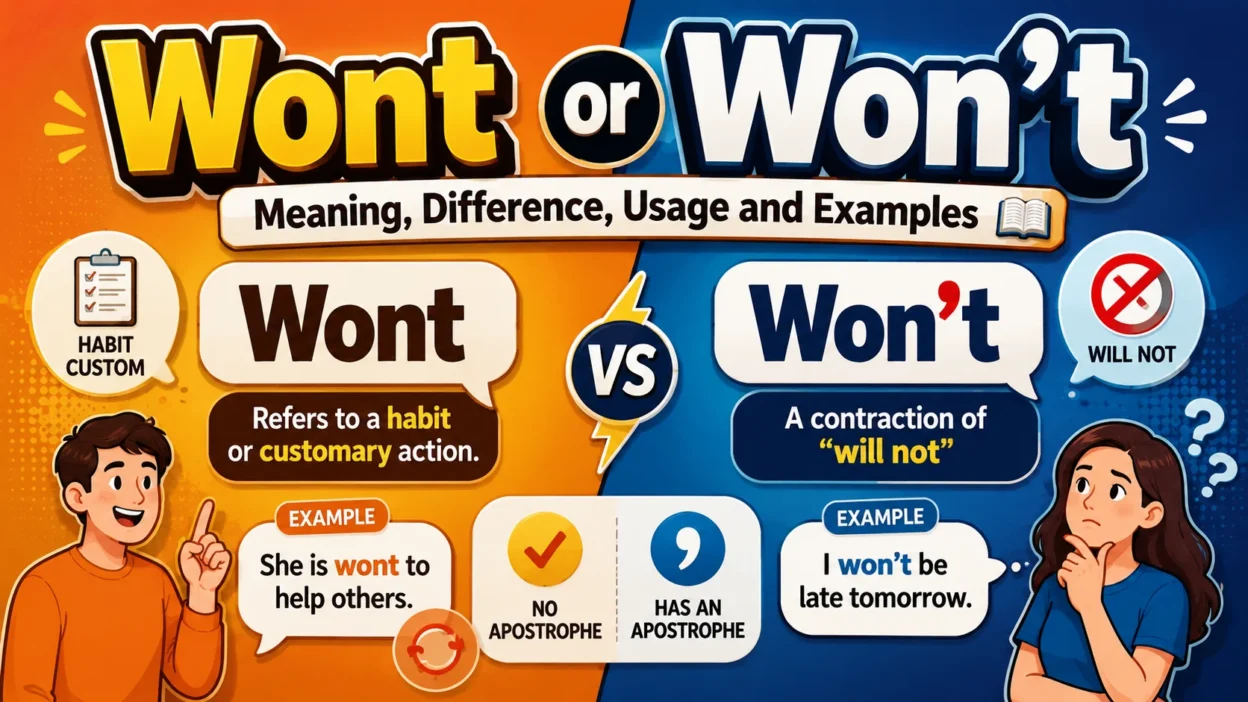
If you are wondering whether wont or won’t is correct, the answer depends on the meaning. Won’t means “will not” and commonly describes future actions, refusal, or unwillingness. Wont means a habit, custom, or usual behavior and appears mainly in formal or literary English. For example, “I won’t go” means “I will not go.” In contrast, “She was wont to read at night” means she usually read at night. The apostrophe creates an important difference between these two words. In this guide, you’ll learn their meanings, differences, examples, grammar, and common mistakes.
⚡ Quick Answer: Wont vs. Won’t
| Term | Meaning | Usage | Category |
|---|---|---|---|
| won’t | will not | Future negation, refusal, or unwillingness | Contraction |
| wont | habit or customary behavior | Formal or literary contexts | Noun |
| wont to | accustomed to or inclined to | Formal/literary expression | Adjective construction |
| will not | Full form of won’t | Formal or emphatic writing | Verb phrase |
💡 Easy Rule to Remember
Won’t = will not
Wont = habit or customary behavior
Try replacing the word with “will not.” If the sentence still makes sense, use won’t.
If you mean “accustomed to” or “in the habit of,” you may need wont.
📖 What Does “Won’t” Mean?
Won’t is the contraction of “will not.” English speakers use it very frequently in conversation and everyday writing.
You can use won’t to express a future negative action:
- I won’t be late.
- She won’t attend the meeting.
- We won’t arrive before noon.
You can also use it to show refusal or unwillingness:
- He won’t apologize.
- She won’t change her mind.
- They won’t cooperate.
The meaning depends on context. In some sentences, won’t simply predicts that something will not happen. In others, it suggests that a person refuses to do something.
🔮 Won’t for Future Actions
Use won’t when you want to make a negative statement about a future action.
I won’t visit the office tomorrow.
This means:
I will not visit the office tomorrow.
The two forms have the same basic meaning, but won’t sounds more natural in everyday communication.
🚫 Won’t for Refusal
Won’t can also communicate refusal.
My brother won’t listen to me.
Here, the sentence suggests that your brother refuses or is unwilling to listen.
You can also use this meaning with objects:
The car won’t start.
The car does not literally make a conscious decision. The sentence means that the car refuses to start or fails to start despite an attempt. English commonly uses won’t this way.
💻 Won’t for Things That Do Not Work
People regularly use won’t when a machine, device, or system does not perform an expected action.
- My laptop won’t turn on.
- The printer won’t connect.
- The door won’t open.
- The website won’t load.
These sentences describe a current problem, even though won’t comes from will not.
📚 What Does “Wont” Mean?
Wont without an apostrophe means habit, custom, or customary behavior.
Unlike won’t, this word does not express future negation.
For example:
He was wont to take a walk after dinner.
This means:
He was accustomed to taking a walk after dinner.
Modern English rarely uses wont in casual conversation. You will mainly encounter it in literary, formal, historical, or traditional writing.
📝 Wont as a Noun
As a noun, wont refers to someone’s usual habit or customary practice.
As was her wont, she arrived early.
This means that arriving early was her usual practice.
Another example:
He followed his usual wont of reading before breakfast.
Here, wont refers to a habitual behavior.
🔤 Wont in “Be Wont To”
You can also find wont in the construction “be wont to.”
This means “be accustomed to,” “usually,” or “tend to.”
Examples:
- She was wont to speak quietly.
- He is wont to arrive early.
- The writer was wont to use humor.
- They were wont to visit the countryside.
Because this construction sounds formal or literary, modern writers often choose usually, tends to, or is accustomed to instead.
🗣️ Pronunciation of Wont and Won’t
Wont and won’t usually sound very similar, and many speakers pronounce them the same or nearly the same depending on their accent.
The apostrophe does not add a separate sound. Instead, it shows that won’t represents the contraction will not.
This similarity makes the words especially easy to confuse when you hear them in conversation.
When you write them, focus on meaning rather than sound:
- Won’t → will not
- Wont → habit or custom
🔎 Wont or Won’t: Key Grammar Differences
| Feature | Wont | Won’t |
|---|---|---|
| Apostrophe | No | Yes |
| Meaning | Habit or custom | Will not |
| Grammatical role | Noun; also appears in “be wont to” | Contraction |
| Frequency | Uncommon | Very common |
| Tone | Formal/literary | Everyday |
| Future negation | No | Yes |
| Refusal | No | Yes |
| Habit | Yes | No |
The apostrophe therefore matters. Removing it from won’t changes the word into wont, which carries a different meaning.
🏛️ Origin and Etymology
Wont has a long history in English and developed from older forms connected with the idea of being accustomed or habitual. The modern word retains that connection through meanings involving customary behavior.
Won’t developed as a contraction of will not. Its spelling may look unusual because the letters in will not do not appear to lead naturally to won’t. Historical English forms influenced the development of this contraction, which eventually became the standard modern form.
Today, the two forms remain completely separate in meaning:
- wont relates to habit.
- won’t relates to will not.
💬 Wont or Won’t: 10 Example Sentences
| Example Sentence | Meaning |
|---|---|
| I won’t forget your advice. | I will not forget it. |
| She won’t attend the party. | She will not attend. |
| We won’t arrive until Friday. | We will not arrive before Friday. |
| He won’t change his decision. | He refuses or does not intend to change it. |
| My computer won’t start. | The computer does not start. |
| The door won’t open. | The door refuses or fails to open. |
| She was wont to read before bed. | She usually read before bed. |
| He was wont to take long walks. | He was accustomed to taking long walks. |
| As was his wont, he arrived early. | Arriving early was his usual habit. |
| The author was wont to use humor. | The author commonly used humor. |
🔄 Synonyms for Won’t
The best alternative depends on the context.
| Synonym or Related Expression | Meaning |
|---|---|
| will not | Direct equivalent |
| refuses to | Shows refusal |
| is unwilling to | Shows lack of willingness |
| declines to | Politely refuses |
| is not going to | Indicates future intention |
| does not intend to | Indicates no intention |
| will never | Strong future negation |
| rejects | Refuses or does not accept |
| avoids | Chooses not to engage |
| cannot be persuaded to | Strong refusal |
📘 Synonyms for Wont
When wont means a habit or customary practice, these words can provide clearer modern alternatives.
| Synonym | Meaning |
|---|---|
| habit | Regular behavior |
| custom | Usual or traditional practice |
| practice | Repeated activity |
| routine | Regular pattern |
| tendency | Common inclination |
| pattern | Repeated behavior |
| tradition | Established practice |
| usual behavior | Typical conduct |
| inclination | Natural tendency |
| practice | Something regularly performed |
↔️ Antonyms of Won’t
The opposite depends on the context, but these words can contrast with won’t:
| Antonym | Meaning |
|---|---|
| will | Indicates future action |
| agrees | Accepts something |
| accepts | Says yes |
| consents | Gives permission |
| intends to | Plans to act |
| plans to | Has a future plan |
| chooses to | Decides to act |
| is willing to | Shows willingness |
| is ready to | Shows readiness |
| agrees to | Accepts a request |
🔗 Related Words and Terms
| Related Word | Meaning |
|---|---|
| will | Auxiliary verb for future meaning |
| will not | Full form of won’t |
| would | Modal verb used in several contexts |
| habit | Repeated behavior |
| custom | Usual practice |
| routine | Regular sequence |
| usually | In most cases |
| typically | In a characteristic way |
| regularly | At consistent intervals |
| accustomed | Familiar through repeated experience |
| tendency | A usual inclination |
| practice | Repeated activity |
| refusal | An act of saying no |
| unwillingness | Lack of willingness |
| contraction | Shortened grammatical form |
🌎 Where Do People Use “Won’t”?
🗨️ Daily Conversation
People use won’t frequently in everyday speech.
“I won’t be late.”
“She won’t come with us.”
The contraction sounds natural and conversational.
📱 Text Messages and Online Chats
You can use won’t freely in texts, chats, and direct messages.
“I won’t forget!”
“He won’t answer my messages.”
📲 Social Media
Social media writers often use won’t because it creates a natural, conversational tone.
“I won’t lie, that ending surprised me.”
💼 Business Communication
You can use won’t in ordinary workplace emails and messages.
“The software won’t connect to the server.”
For highly formal documents, however, will not can provide a more formal tone.
🎓 Academic Writing
Academic writers may prefer will not in formal papers.
Compare:
The results won’t affect our conclusion.
with:
The results will not affect our conclusion.
Both forms are grammatically correct, but the second option generally fits formal academic prose better.
⚠️ Common Mistakes: Wont vs. Won’t
| Mistake | Correct Usage |
|---|---|
| I wont go. | I won’t go. |
| She wont agree. | She won’t agree. |
| They wont arrive tomorrow. | They won’t arrive tomorrow. |
| I won’t to walk every morning. | I was wont to walk every morning. |
| He was won’t to complain. | He was wont to complain. |
| As was his won’t, he left early. | As was his wont, he left early. |
| She is wont going there. | She is wont to go there. |
| My computer wont start. | My computer won’t start. |
| I wont forget. | I won’t forget. |
| Wont you help me? | Won’t you help me? |
💡 A Simple Substitution Test
When you cannot decide between wont and won’t, use this quick test.
Step 1: Replace the word with “will not.”
I won’t attend.
I will not attend. ✓
Use won’t.
Step 2: Try “accustomed to” or “in the habit of.”
He was wont to arrive early.
He was accustomed to arriving early. ✓
Use wont.
Step 3: If neither replacement works, check whether you actually mean want.
For example:
I want a new phone.
Here, want expresses desire. Neither wont nor won’t works.
❓ Frequently Asked Questions
Is “wont” a real English word?
Yes. Wont is a real English word that refers to a habit, custom, or customary behavior. It appears mainly in formal and literary contexts.
Is “won’t” short for “will not”?
Yes. Won’t is the standard contraction of “will not.”
Are wont and won’t pronounced the same?
They usually sound the same or very similar, depending on the speaker’s accent. The spelling and meaning distinguish them.
What does “be wont to” mean?
“Be wont to” means “be accustomed to,” “usually,” or “tend to.” It often appears in formal or literary writing.
Is “wont” common in modern English?
No. Wont is relatively uncommon in everyday conversation. Modern writers often replace it with usually, tends to, or is accustomed to for clarity.
Which form should I use in everyday writing?
Use won’t when you mean “will not.” You will rarely need wont in ordinary everyday writing.
Can “won’t” describe a machine?
Yes. English speakers commonly say things such as “The computer won’t start” or “The car won’t move.”
Is “wont” the same as “want”?
No. Wont means habit or customary behavior, while want expresses desire or need.
🎯 Conclusion
The difference between wont or won’t becomes easy when you focus on the meaning. Won’t means “will not” and describes future negative actions, refusal, or unwillingness. Wont means “habit,” “custom,” or “customary behavior” and usually appears in formal or literary writing. You may see it in phrases such as “be wont to” and “as was his wont.” For everyday English, won’t is much more common. If “will not” fits the sentence, use won’t; if “accustomed to” fits, use wont. Remember, a tiny apostrophe can completely change the meaning of the word.

Andrew Foster is a researcher and content writer at Differopedia, specializing in clear, accurate, and easy-to-understand comparison guides, definitions, and informational articles. His work focuses on helping readers make informed decisions through well-researched, reliable content.