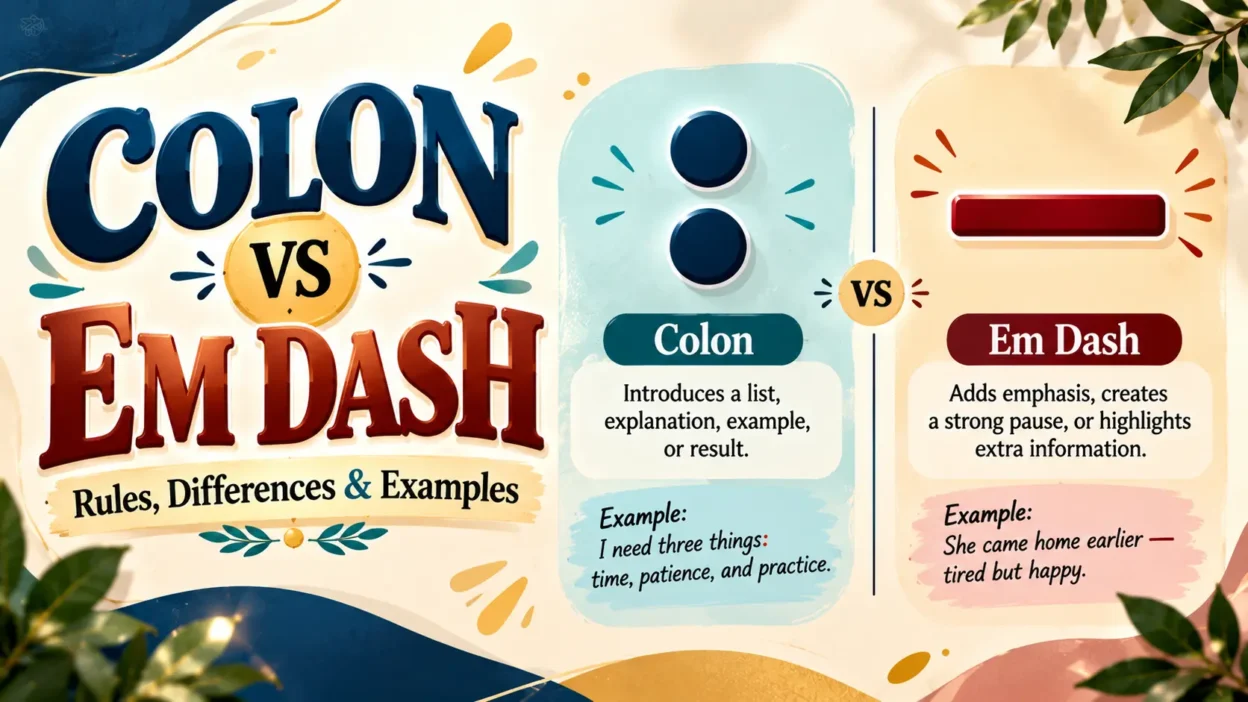
When comparing colon vs em dash, the main difference lies in how each punctuation mark connects ideas. A colon (:) introduces a list, explanation, example, or result. An em dash (—) adds emphasis, creates a dramatic pause, or introduces an extra thought.
For example, look at these sentences:
- Colon: I need three things: a notebook, a pen, and a ruler.
- Em dash: I need one thing—a little more time.
The colon introduces a list, while the em dash highlights an idea. Both marks improve your writing, but they create different effects.
Understanding colon vs em dash helps you write better emails, essays, blog posts, stories, and social media captions. In this guide, you’ll learn the definitions, grammar rules, differences, examples, and common mistakes associated with both punctuation marks. We’ll also explore when to choose one over the other so you can communicate clearly and confidently.
⚡ Colon vs Em Dash:
| Feature | Colon (:) | Em Dash (—) |
|---|---|---|
| Main purpose | Introduces related information | Adds emphasis or interrupts a thought |
| Common use | Lists, explanations, examples | Emphasis, interruptions, extra details |
| Tone | Organized and formal | Dramatic and conversational |
| Example | She brought three items: food, water, and blankets. | She brought everything—except the blankets. |
| Spacing | Usually no space before it | Style guides vary on spacing |
| Best for | Structured information | Emphasis and sudden shifts |
Quick rule: Use a colon when you want to introduce information clearly. Use an em dash when you want to emphasize an idea, create a pause, or add an interruption.
📖 What Is a Colon? Definition and Usage
A colon (:) is a punctuation mark that connects a complete introductory statement to information that explains, illustrates, or expands on it.
🔤 Pronunciation and Grammar
- Name: Colon
- Pronunciation: KOH-lun
- Part of speech: Punctuation mark
- Symbol: :
- Origin: The word comes from the Greek kōlon, meaning a part or member of a sentence.
Writers commonly use colons in essays, business documents, instructions, and everyday writing.
📝 Examples of Colons
- I have one goal: to finish my project today.
- Bring these supplies: paper, scissors, and glue.
- She understood the problem: nobody had checked the schedule.
- Remember this rule: practice improves your writing.
Each colon introduces information that develops the statement before it.
➖ What Is an Em Dash? Definition and Usage
An em dash (—) is a long punctuation mark that creates a strong break in a sentence. Writers use it to emphasize information, insert an interruption, or introduce an explanation.
The em dash gets its name from traditional typography, where its width roughly matched the width of a capital M in a given typeface.
🔤 Pronunciation and Grammar
- Name: Em dash
- Symbol: —
- Part of speech: Punctuation mark
- Main function: Emphasis, interruption, and parenthetical information
Unlike a colon, an em dash can create a more dramatic or informal effect.
📝 Examples of Em Dashes
- I had one plan—start again.
- My brother—who rarely arrives early—was the first to arrive.
- She opened the box—and immediately gasped.
- There was only one problem—we had forgotten the tickets.
Em dashes help readers notice important details and follow changes in thought.
⚖️ Colon vs Em Dash: Key Differences
Although both punctuation marks introduce related information, they serve different purposes. The colon emphasizes structure, while the em dash often emphasizes tone or a sudden shift in thought.
| Difference | Colon (:) | Em Dash (—) |
|---|---|---|
| Introduces a list | Yes | Yes, for emphasis |
| Introduces an explanation | Yes | Yes, often dramatically |
| Shows interruption | Rarely | Yes |
| Adds an extra thought | Sometimes | Frequently |
| Creates dramatic emphasis | Less often | Frequently |
| Fits formal writing | Very well | Depends on context |
| Requires a complete clause before it | Usually, in standard prose | Not always |
✨ Compare These Sentence Pairs
- Colon: She had one wish: to see the ocean.
- Em dash: She had one wish—to see the ocean.
Both sentences communicate the same idea, but the colon sounds more structured, while the em dash creates a more flowing connection.
- Colon: The answer was simple: we needed more time.
- Em dash: The answer was simple—we needed more time.
Choose the colon for a clear explanation. Choose the em dash when you want a stronger pause or more emphasis.
📚 When Should You Use a Colon?
Use a colon when the information that follows explains, identifies, or expands on the statement before it.
1. 📋 To Introduce a List
- Pack these essentials: clothes, toiletries, and snacks.
- Three subjects interest me: history, science, and literature.
2. 💡 To Introduce an Explanation
- She missed the meeting for one reason: her car broke down.
- We reached the same conclusion: the plan needed changes.
3. 🗣️ To Introduce a Quotation
– The teacher offered this advice: “Practice a little every day.”
4. 🎯 To Emphasize a Conclusion
– He finally understood the truth: success requires patience.
Grammar tip: In standard prose, place a colon after a complete introductory clause when it introduces a list or explanation. Avoid placing one directly between a verb and its object.
Incorrect: My favorite fruits are: apples, grapes, and oranges.
Correct: My favorite fruits are apples, grapes, and oranges.
You can also write, “My favorite fruits include these: apples, grapes, and oranges.”
➖ When Should You Use an Em Dash?
An em dash works well when you want to create emphasis, insert extra information, or signal an interruption.
1. 🔥 To Emphasize an Idea
- She finally achieved her dream—graduating from college.
- I wanted just one thing—an honest answer.
2. 🧩 To Add Extra Information
- My cousin—who lives in Chicago—visits every summer.
- The new laptop—lightweight, fast, and affordable—fits my needs.
3. 💬 To Show an Interruption
- “I thought you said—”
- “Wait—I can explain!”
4. 🎭 To Create a Dramatic Pause
- He opened the letter—and everything changed.
- There was only one choice—leave before sunrise.
Use em dashes thoughtfully. Too many can make an article feel choppy, so choose commas, parentheses, or periods when they communicate your meaning more clearly.
✍️ Colon vs Em Dash: 10 Practical Examples
The following examples show how each punctuation mark changes the flow of a sentence.
| Example sentence | Meaning or purpose |
|---|---|
| 1. I need three items: milk, bread, and eggs. | The colon introduces a list. |
| 2. I need only one thing—your support. | The dash emphasizes the request. |
| 3. She had one goal: to win the competition. | The colon explains the goal. |
| 4. She had one goal—to win the competition. | The dash creates a flowing emphasis. |
| 5. Remember this rule: always check your work. | The colon introduces advice. |
| 6. Remember this—always check your work. | The dash adds emphasis. |
| 7. My friend—an excellent writer—helped me. | The dashes enclose extra information. |
| 8. The truth was clear: nobody had prepared. | The colon introduces an explanation. |
| 9. I almost called you—but I changed my mind. | The dash marks a shift in thought. |
| 10. We reached the final decision: postpone the launch. | The colon introduces the decision. |
🚫 Common Colon and Em Dash Mistakes
Avoid these common errors to make your writing clearer and more professional.
| Mistake | Correct usage |
|---|---|
| Adding a colon after every introductory phrase | Use a colon when the preceding text appropriately introduces what follows. |
| Writing “She likes: tea and coffee.” | Write “She likes tea and coffee.” |
| Using a hyphen instead of an em dash | Use — for an em dash, not -. |
| Using a colon for every dramatic pause | Choose an em dash when you want stronger emphasis. |
| Adding too many em dashes | Use periods, commas, or parentheses where appropriate. |
| Using an em dash to join unrelated ideas | Connect ideas that have a clear relationship. |
| Using inconsistent dash spacing | Follow one style guide consistently. |
| Confusing an em dash with an en dash | Use — for an em dash and – for an en dash. |
| Adding a colon before a list without a complete introduction | Rewrite the sentence to provide a suitable introductory clause. |
| Replacing every colon with an em dash | Choose punctuation according to the sentence’s purpose. |
🔎 Related Punctuation Terms You Should Know
Understanding these related punctuation marks can help you choose the right one.
| Punctuation mark | Symbol | Main purpose |
|---|---|---|
| Colon | : | Introduces explanations and lists |
| Em dash | — | Adds emphasis or marks interruptions |
| En dash | – | Shows ranges or relationships |
| Hyphen | – | Joins words or word parts |
| Semicolon | ; | Connects closely related independent clauses |
| Comma | , | Separates sentence elements |
| Parentheses | ( ) | Enclose additional information |
| Period | . | Ends a statement |
| Ellipsis | … | Indicates omitted text or a trailing thought |
| Quotation marks | “ ” | Enclose direct speech or quotations |
For example, write “pages 10–20” with an en dash to show a range, but use “a well-known author” with a hyphen to connect words. The em dash serves a different purpose: it creates a break or emphasizes information.
🌎 How Colon vs Em Dash Works in Real Life
Different writing situations call for different punctuation choices.
- Daily conversation: Use an em dash to capture pauses and changes in thought. Example: “I was ready to leave—but my phone rang.”
- Social media: Use em dashes for dramatic captions. Example: “One goal—make today count.”
- Business communication: Use colons to introduce lists, action items, or explanations. Example: “Please complete these tasks: review the report, update the figures, and send the draft.”
- Academic writing: Use colons to introduce evidence or explanations. Use em dashes when they improve clarity and fit your required style guide.
- Online messaging: Use either mark naturally, but avoid excessive punctuation that distracts readers.
❓FAQs
Can an em dash replace a colon?
Yes. An em dash can introduce a list or explanation when you want a stronger, more conversational effect. However, a colon often works better in formal or structured writing.
Is an em dash more informal than a colon?
An em dash often creates a conversational or dramatic tone, but it also appears in formal books and professional writing. The right choice depends on context.
Should you put spaces around an em dash?
American publishing styles often use an unspaced em dash, like this: “The answer—finally—became clear.” Some publications and digital platforms prefer spaces. Follow your chosen style guide.
Can you use a colon after a complete sentence?
Yes. A colon can follow a complete clause when the next part introduces a list, explanation, quotation, or related information.
What is the difference between a colon and a semicolon?
A colon introduces information that explains or develops the preceding clause. A semicolon connects closely related independent clauses or separates complex list items.
Which punctuation mark works better for essays?
Both can work well. Use colons for organized explanations and evidence. Use em dashes sparingly when you need emphasis or additional context.
Is an em dash the same as a hyphen?
No. A hyphen (-) joins words, an en dash (–) commonly indicates ranges, and an em dash (—) creates a break or adds emphasis.
✅ Conclusion: Colon vs Em Dash
The main difference between a colon and an em dash lies in structure and emphasis. A colon introduces a list, explanation, quotation, or result, while an em dash creates a pause, adds emphasis, or introduces extra information. When writing essays, emails, articles, or social media posts, choose the punctuation mark that best fits your meaning. Use a colon to present information clearly and an em dash to create a stronger impact. Neither punctuation mark works best in every situation, so consider your tone and sentence structure. With practice, you’ll use both confidently and make your writing clearer and more effective.

Andrew Foster is a researcher and content writer at Differopedia, specializing in clear, accurate, and easy-to-understand comparison guides, definitions, and informational articles. His work focuses on helping readers make informed decisions through well-researched, reliable content.